ABOUT THE EXHIBITION
媒体包
Originally built to store oil and aviation fuel, the industrial structures of TANK Shanghai once held latent physical energy meant to power cities and machinery. In Art Machine, Analia Saban transforms TANK’s monumental space into a vessel for a different kind of fuel: human creativity, intellectual drive, and the logic of computers. By converting the tank into a machine for art and ideas, Saban reflects on how our daily interaction with digital devices, algorithms, and artificial intelligence is reshaping the creative process.
Analia Saban is known for her experimentation with materials and her investigations into how we perceive and understand objects as works of art, as well as the intersection of digital and analogue processes. Spanning textile, sculpture, technology, and moving image, Art Machine brings together four recent interconnected series that explore the connections between handmade, traditional craftsmanship and digital infrastructure.
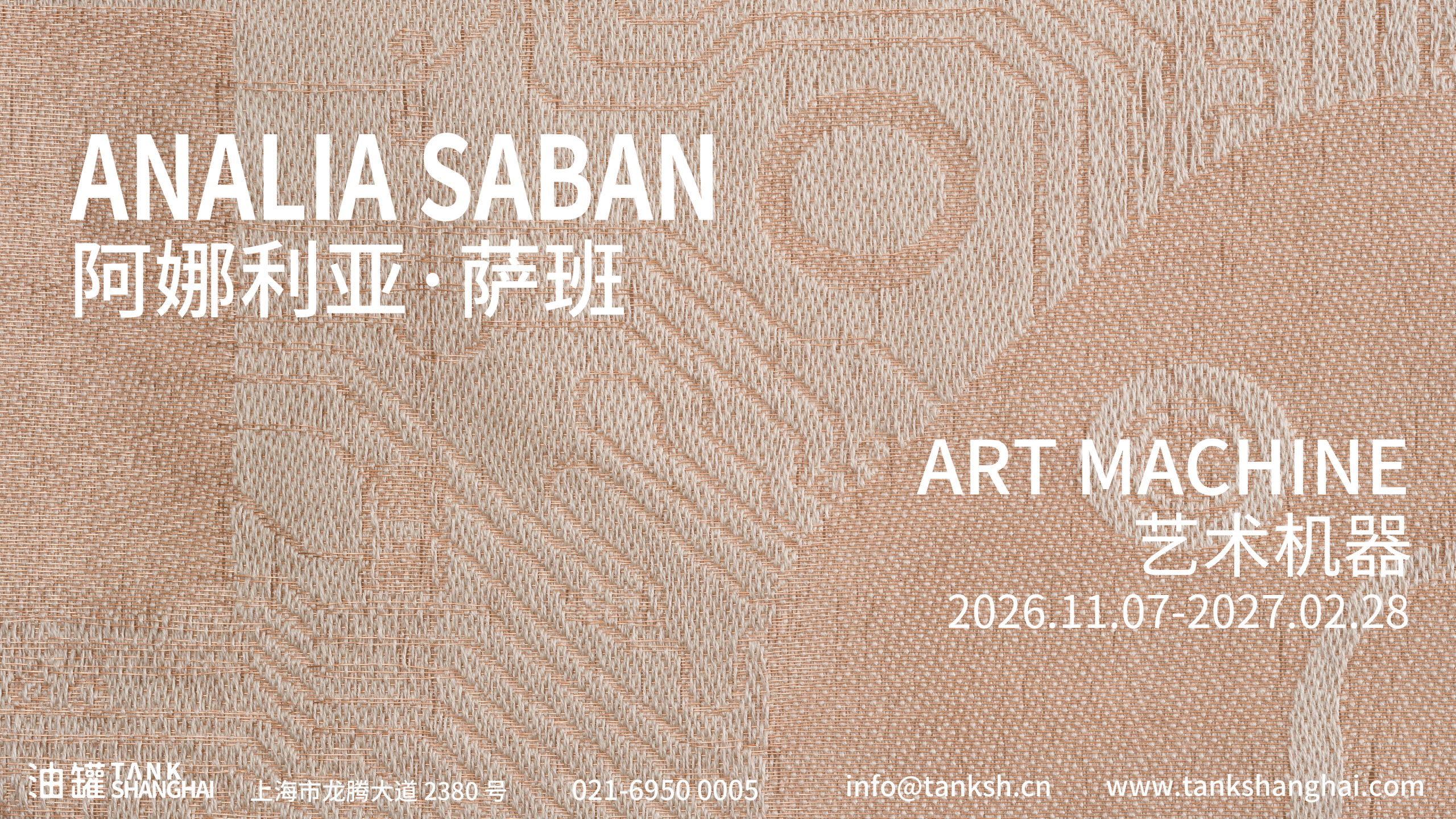
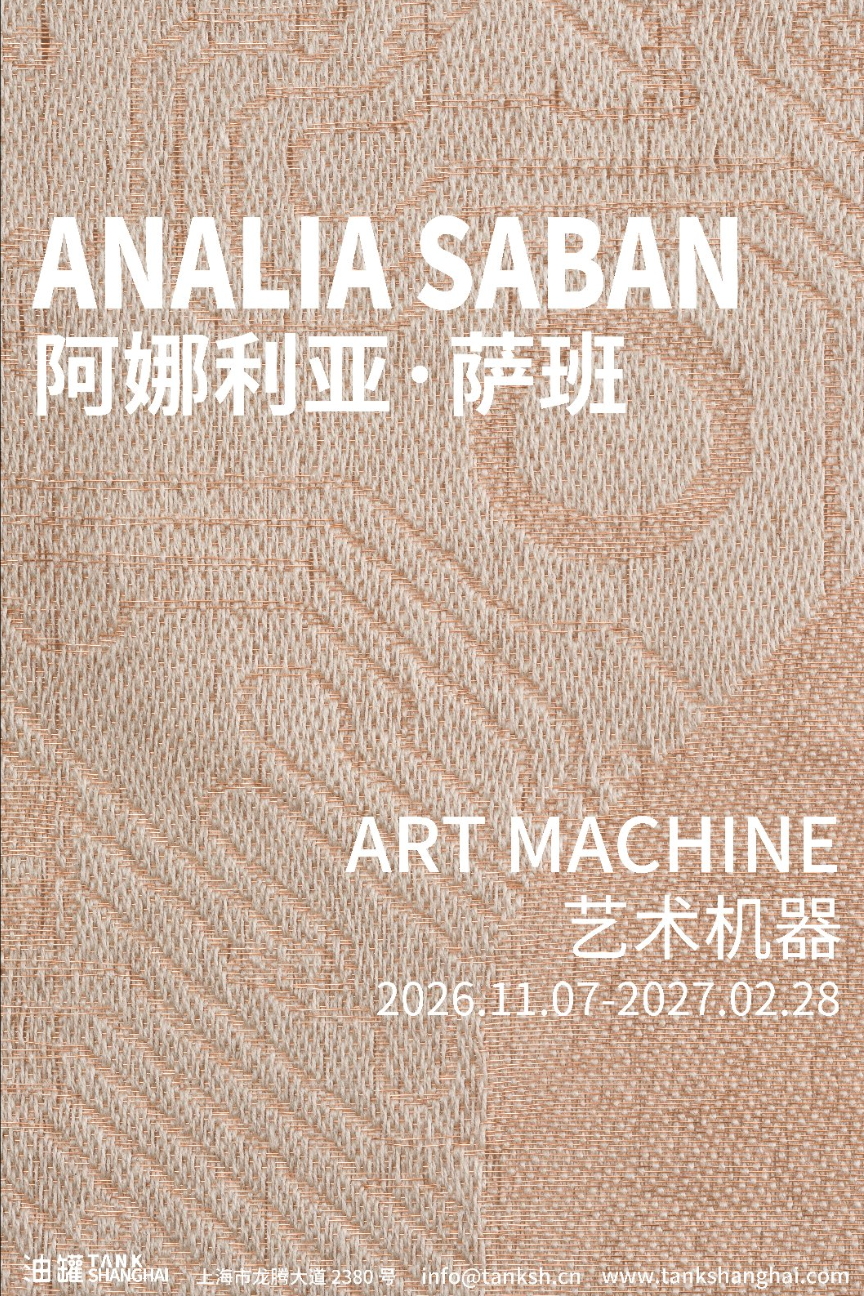
At the center of the tank, draped across its massive ceiling, a 33-meter-long, scroll-like tapestry unfurls over the exhibition space. Woven from raw linen thread and conductive red copper wire, the tapestry depicts an array of circuit boards—a symbol of hyper-connectivity and modern infrastructure through which passes human knowledge and information. The shining red of the copper wire suggests an emblem of good luck and prosperity, while the scroll format evokes an uncoiling reservoir of thought and technological flow. At the same time, the work’s shape resembles the linear format of traditional Chinese handscrolls, which are meant to be read section by section in an intimate, ritualized encounter between viewer and object. Here, the tapestry is fully unfolded and displays its image all at once, ready for viewers to “read” it at their own pace as they move through the exhibition space in the direction of their choice.
Hanging serially along the TANK walls, individual tapestries, woven from linen and natural copper wire, evoke the continuous movement of turning blades and mechanical cycles. Like a dial perpetually turning, the rotating lines of each abstract composition recall the rhythmic operation of a machine. In these works, the copper represents not just an aesthetic choice—connecting them to the long history of tapestry and the use of regal metallic threads—but also an electrically conductive material that is often built into digital circuitry itself.
The flow of data and its relationship to making meaning is a theme of another major work in Art Machine. Projected across one of TANK’s massive walls, a video animation displays Saban’s Flowchart series, originally created as large-scale encaustic panels made of beeswax, resin, pigment, and oil stick, and now transformed into vector animations. Appearing one by one in the artist’s handwriting, diagrams translate complex aesthetic human decisions about art making—how to select substrates and brushes, draw anatomy or landscapes, develop a signature—into computer flowchart language with “starts,” “stops,” inputs and outputs. Part flowchart, part prompt, the video asks what it truly means to teach a machine how to paint or draw and what remains uniquely human at this pivotal crossroads of AI, art, and technology.
Bringing literal computer parts into Art Machine, Saban’s Motherboard series comprises computer motherboards encased in layers of black printer’s ink and bounded by custom walnut frames. Stripped of their previous communicative function, these components are inert, contemporary archaeological artifacts from a recent past. Yet Saban’s use of unctuous, rich materials, as well as her attention to texture and detail, gives the Motherboards new layers of aura and intrigue, imagining the data that once passed through them.
Designed to be experienced within TANK’s particular setting, the works in Art Machine generate a space for thinking, where historical energy meets modern intelligence. With its material experimentation and blend of analog and digital methods, Saban’s work urges visitors to contemplate how we construct ideas, store memory, and envision creativity in an increasingly automated world.
ABOUT THE ARTIST
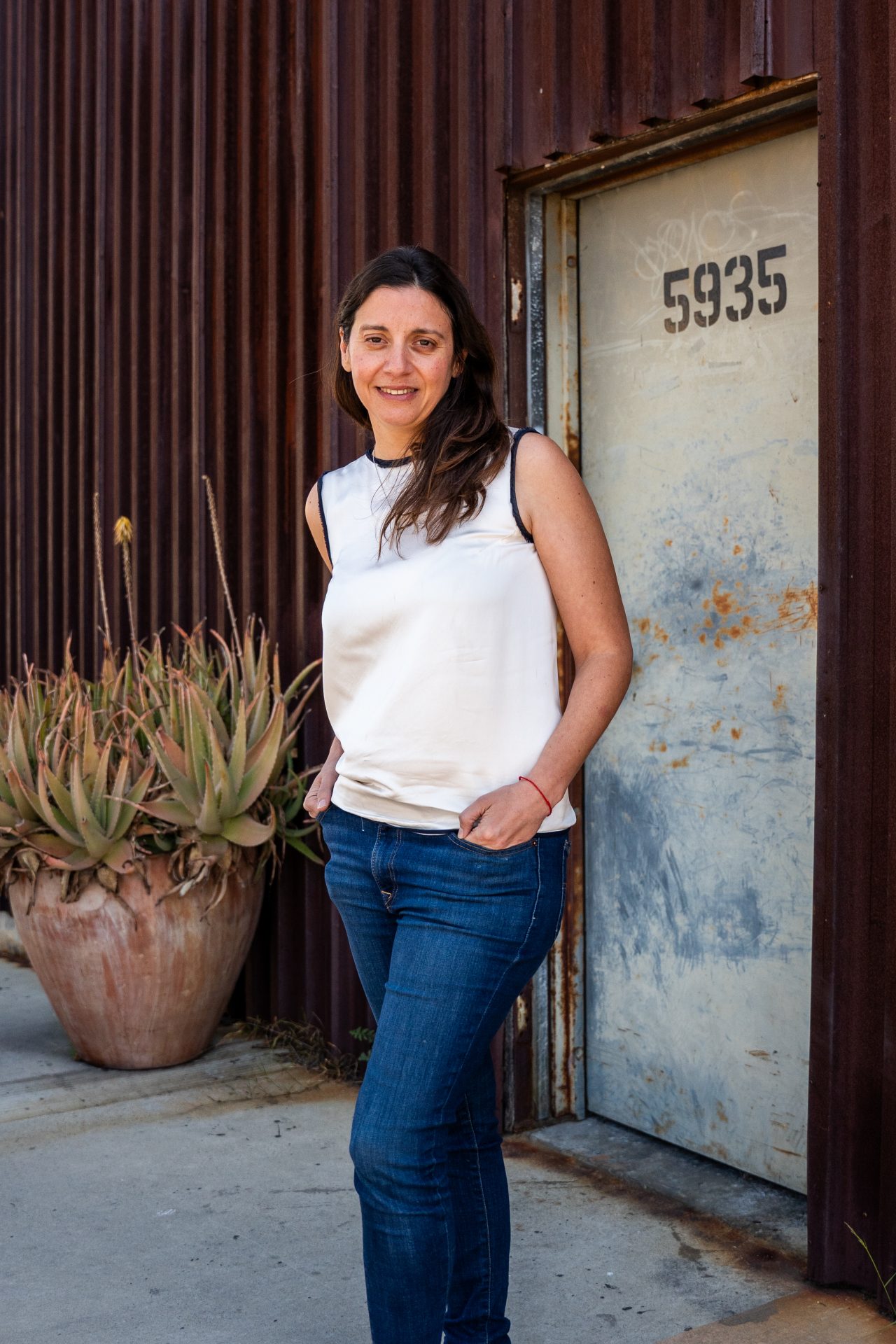
ANALIA SABAN
Analia Saban works across a broad spectrum of mediums exploring how art objects are conceived, constructed, and understood. Her paintings, sculptures, photographs and works on paper are deeply engaged with the basic tools of art-making: While she uses traditional materials (pigments, acrylic, linen, wood, copper, marble, wax), she completely rethinks the concept of what an artwork physically entails. In so doing, she consistently expands viewers’ expectations of what might constitute a “painting” or “sculpture,” creating inventive hybrid forms that complicate these categories. Saban’s work remains in dialogue with modernist legacies, including those of abstract painting and conceptual art, and at the same time deconstructs artistic conventions, introducing elements of craft, design and everyday materials. And though Saban approaches her works from a conceptual angle, they remain vibrant, tactile objects that carry with them a distinct sense of inquiry and wonderment, even as they tackle fundamental questions about art and its meaning within contemporary culture. Analia Saban (*1980, Buenos Aires) lives and works in Los Angeles. In 2027, a major survey of her work will be on view at the Los Angeles County Museum of Art and the Kemper Museum of Art, University of Washington, St. Louis. Other solo exhibitions include Modern Art Museum Fort Worth (2019), Qiao Space, Shanghai (2017–18), Blaffer Art Museum, Houston (2016), and Armory Center for the Arts, Pasadena (2014). Selected group exhibitions include those at , Hessel Museum of Art, Center for Curatorial Studies, Bard College (2026), Henry Art Gallery at University of Washington, Seattle (2026), Massachusetts Museum of Contemporary Art, North Adams (2026), Museum of Modern Art, New York (2025), Palacio Libertad, Buenos Aires (2025), National Gallery of Art, Washington, DC (2024), Getty Research Institute, Los Angeles (2024), Los Angeles County Museum of Art (2023), Sheldon Museum of Art, Lincoln, Nebraska(2022), Clark Art Institute, Williamstown, MA (2020), Hammer Museum, Los Angeles (2018), Aïshti Foundation, Beirut (2016), The National Museum, Oslo (2014), and Palais de Tokyo, Paris (2013). Saban’s work has been featured in theNew York Times,Los Angeles Times,andArtforum, and is in the collections of Museum of the Modern Art, New York; NationalGallery of Art, Washington, DC; Centre Pompidou, Paris; Museum of Contemporary Art,Los Angeles; Los Angeles County Museum of Art; Museum of National Gallery of Victoria,Melbourne; and Museum of Latin American Art, Buenos Aires, among many others.