ABOUT THE EXHIBITION
PRESS KIT
As a Belgian artist who has gained worldwide attention recently, Eyckermans uses his painting practice as a transit point to connect not only to the Flemish artistic tradition that runs deeply in his blood, but also to his personal experiences and fantasies with the spectator. Inspired by this, the exhibition at TANK Shanghai will focus on the essence of daily life, conveying the artist’s bright, calm and witty qualities to the spectator.
Eyckermans’ creative process is divided into two main stages. The first is the reorganization of “legacy”. As the fifth generation of sculptors, the artist works in the same studio as his grandfather and father, thus inherits the objects and artworks collected or created by his predecessors. After examining these objects over the years, he rearranges, transforms and uses them as the main subject of his paintings. These deliberately composed “narratives” often reflect his feelings and imagination, transforming people and objects that were not inclined into scenes with personality. In this creative process, the artist dissolves certain events in his life, combining objective objects into an intimate and subjective context.
Then comes the second stage, the transformation of the reconstituted “legacy” into paintings. He continues to find a physical yet poetic expression for the products of the first stage: multi-view compositions, dramatic light and shadows, and stereotypical movements especially imposed on the figures, which seem to stop time in the paintings and carry a great sense of emptiness and uncertainty. At the same time, Eyckermans inherits the realistic and exquisite style of Flemish art, which allows him to keep the painting in a sense of certainty. While the “legacy” that he orchestrates and shapes are deliberately enlarged in the painting, occupying the spectator’s attention in an abrupt manner, the rest of the precisely outlined white space remains silent. In this process, the artist’s subjective emotions are gradually dissolved by the sense of form contained in his paintings, and the spectator can return to the objective world at any time. However, the artist has used his paintings to inspire a new perspective of viewing, a perspective through which people may have new illusions when they look at everyday life anew.
Text from Bendt Eyckermans
Although there is often a personal intention in the narrative of the painting, there is never the purpose to give an absolute meaning or reasoning about the narration — only to quest the spectator into a search for meaning and structure by their own associative reading and thinking of the painting. The absoluteness lies in the freedom to read and give form to the reading of one’s own visual language/vocabulary, a visual language formed without restrictions and constrictions to all sources of information.
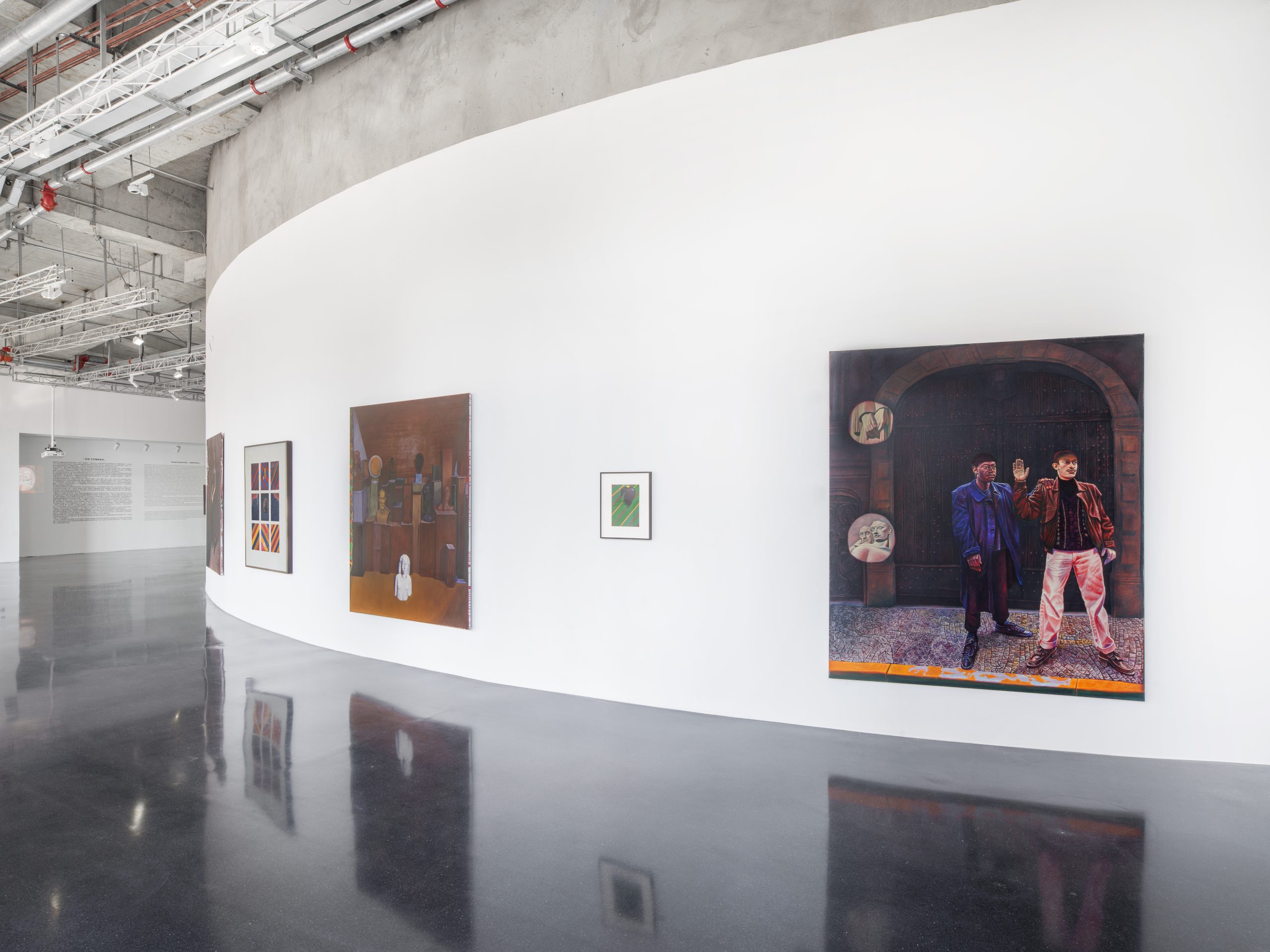
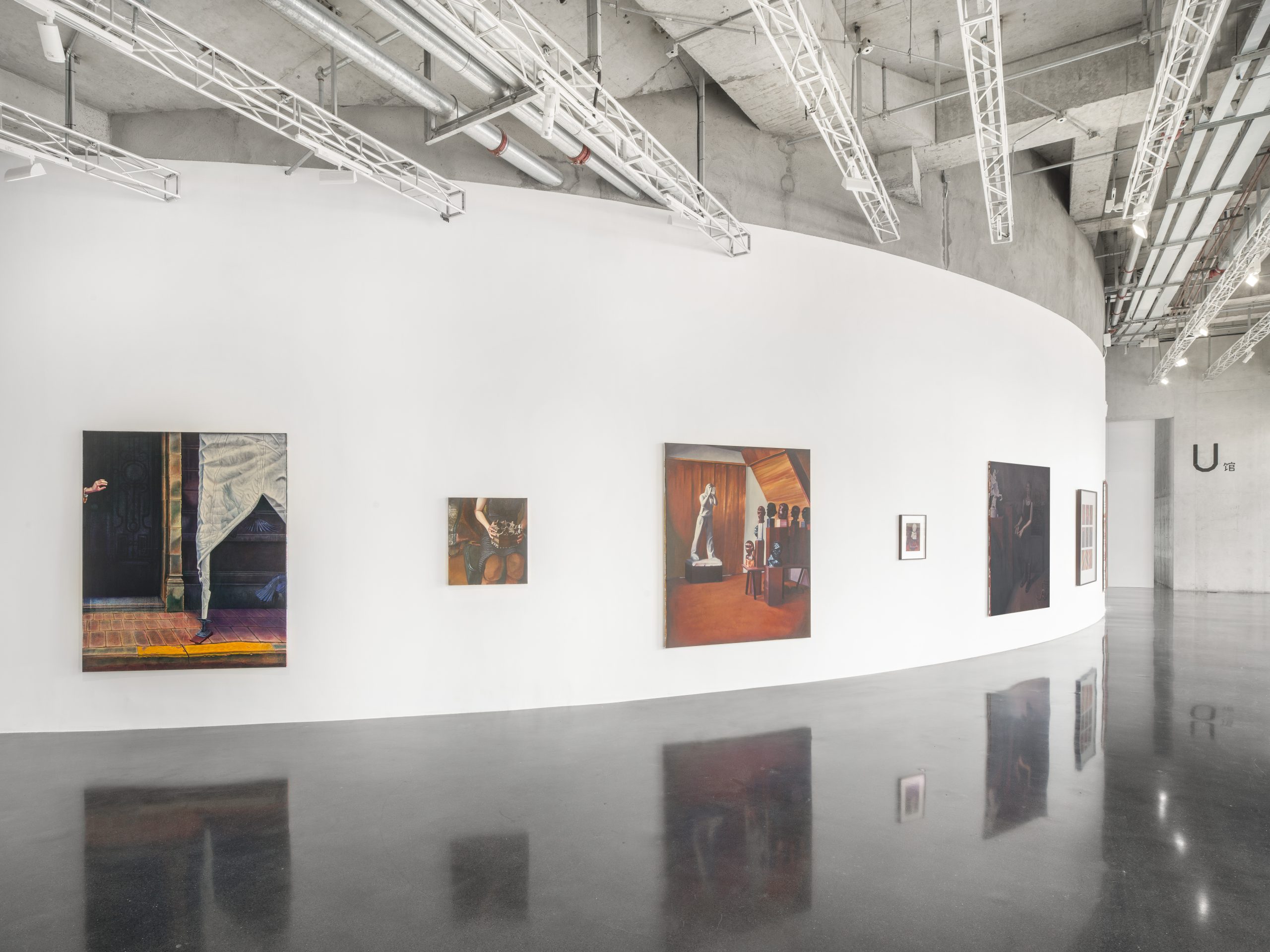
In this exhibition you will see different settings of interiors — excluding the two opposing outer works, which are both street-scenes. Within these spaces I compose different sculptures — they are collected, hoarded and created artworks/decorations, by the previous generations of Eyckermans that lay scattered throughout my family’s studio, where I work. These objects are fragmentations of different oeuvres, time periods and personalities. Most of them have lost their significance and context.
With these objects and remnants, I play in composition, structure and assemble them into new narratives that fit the context of the subject (like James Ensor would create effigies formed out of his clothing and masks to create different political and social narratives; or like Auguste Rodin who made assemblies from fragments of different sculptures and ornaments into new mythological narrations). Some of those sculptures I have altered into the likeness of close friends or relatives (see ‘a rhythm’, ‘The pleaser’ or ‘The aunt’), to create an internal dynamic and personal dialogue with its environment, lighting and main subject.
The paintings often contain a personal intention to give myself a “reason” to create this image. I say often and not always, because it can as well be a subject formed for me to study, and practice, the application of light, colour and composition by painting. I cannot mobilize to create without it having a personal purpose or meaning, there will always be a personal gain or feeling that I want to express so that I can have a reason for a creation to come into existence. The narrative’s personal definition is something that I prefer to keep hidden from others because it is mostly banal or not interesting — I believe as well that it will otherwise stamp the work with an anecdote which disillusions and halts the spectator’s imagination by giving the imagery an absolute meaning. That said, I do want to give contextual information for the paintings.
The source from which the ideas derive is everything that exists in my everyday life. The content of everything that you see in the painting is all based upon real spaces, real objects, real people and the Belgian cultural heritage. Every object, ornament, lighting, environment and character is carefully composed, purposed, arranged, structured, appropriated and/or altered into an internal dynamic to create meaning. They enter the spectator’s mind and contribute to its transformation — in the hopes that, as the viewer reads these components, it will guide their reading within an own sociocultural associative thinking.
‘The aunt ’exists in the same space as ‘A rhythm’, it is a marble sculpture altered to the likeness of a family member of mine who had a strong authority within the family dynamics. Her portrait is guarding or blocking the way to the arranged pedestals and sculptures.
Even after death, remnants of some deceased relatives remain in the mind as a “god’s voice”. Guiding the person in commands and advice. This concept becomes stronger when you are surrounded by their effigies.
Just as I repurpose and reappropriate the sculptures and objects to create new narratives, I suppose that I as well selected this series of paintings together for it to represent the handling of a legacy.
The first painting ‘Het feest ’(translated ‘The feast’) is influenced by Flemish symbolism from throughout the centuries (e.g. the works of Gustave Van de Woesteyne’s ‘The bad sower’ where the birds are omens, or the dynamics in composition coming from the birds and hunters entering Bruegel’s ‘Hunters in the snow’).
While on the opposing sides of the installation you can observe the painting ‘Het slot’ (‘The close’) of which the two floating orbs are based upon the visual storytelling of some Flemish miniature paintings (e.g. Philippe de Mazzarole’s ‘the crucifixion’ or Quinten Massys’s O.F.L. The seven contractions). The orbs are visually a separate story but the tension it creates by the interaction with the main scene is what I find exciting.
There are technical references also – in ‘A rhythm’ you see a certain degradation or deterioration of the paint redacting entities from the narration. This is inspired upon one of my absolute favourite paintings, because of how the passing of time has beautifully deteriorated this work, which is Dieric Bouts’ ‘The crucifixion of Christ’. Every time when I visit Brussels I go and see this painting in the Royal Museum of Fine Arts. In essence this work has been severely damaged, most of its essential pigments have been lost and degraded, which causes characters depicted to be only visible by a cavity or fragments that outlines an entity. Withinthese cavities remnants of their character by, for example, their shoes or some painted clothing/textiles remains, making it an almost modernistic abstraction.
These influences are a wink to the Belgian legacy on which I as well build and from where I repurpose visual concepts/symbols that coalesce with my own personal narration.
‘A ponder’ / ‘Ornaments and colour schemes’ are based upon heraldic family shields, which would depict professions and some form of honour of their family. The objects painted upon the colour schemes are recovered ornaments that I have been hoarding from demolished buildings in Antwerp. I thought it would parallel nicely with the historical preservation that is also integrated into the subject of the other paintings.
ABOUT THE ARTIST
Bendt Eyckermans
Bendt Eyckermans
b. 1994, Belgium
Lives and works in Antwerp
2016, MFA Painting, Royal Academy of Fine Arts, Antwerp
Solo Exhibitions
2022
Bendt Eyckermans, TANK Shanghai, Shanghai
An Introcosm, Andrew Kreps Gallery, New York
2019
Blue Shadow, Gallery Sofie Van de Velde, Antwerp Yellow leaves, Carlos/Ishikawa, London
2018
A Stranger’s Hand, De Vereniging, S.M.A.K., Ghent Bendt Eyckermans, Kusseneers Gallery, Brussels
2017
The Clouds Have Gathered, Kusseneers Gallery, Brussels
INSTALLATION VIEW